Discovery · AI · Prototype
Interesting eBay
A feed of the weird, rare and suddenly popular things on eBay, for browsing rather than searching.
The idea
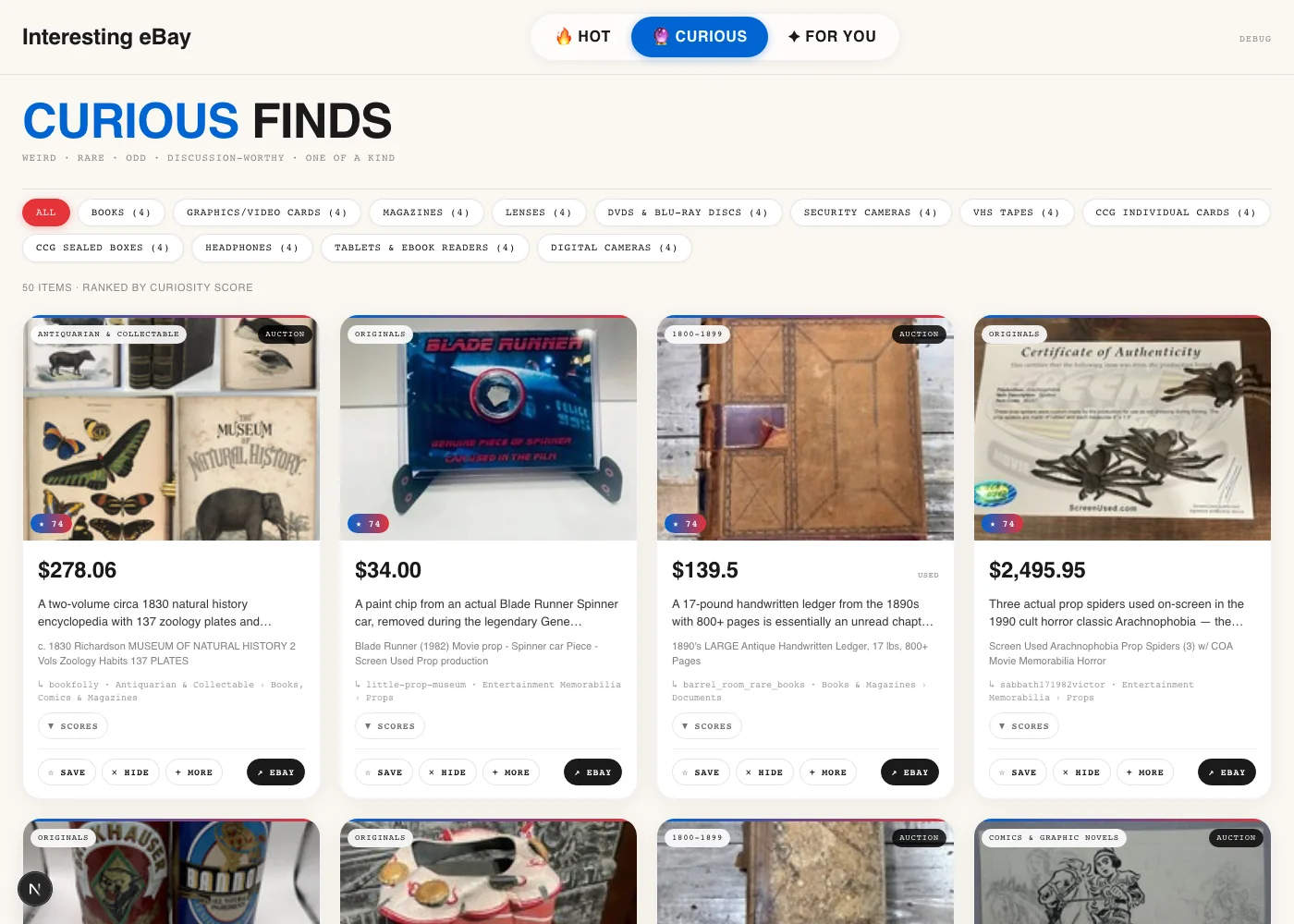
Search is for people who know what they want. The listings people talk about, like a Blade Runner prop or a 17-pound ledger from the 1890s, rarely surface that way. Interesting eBay is a feed built for stumbling onto them.
Three feeds
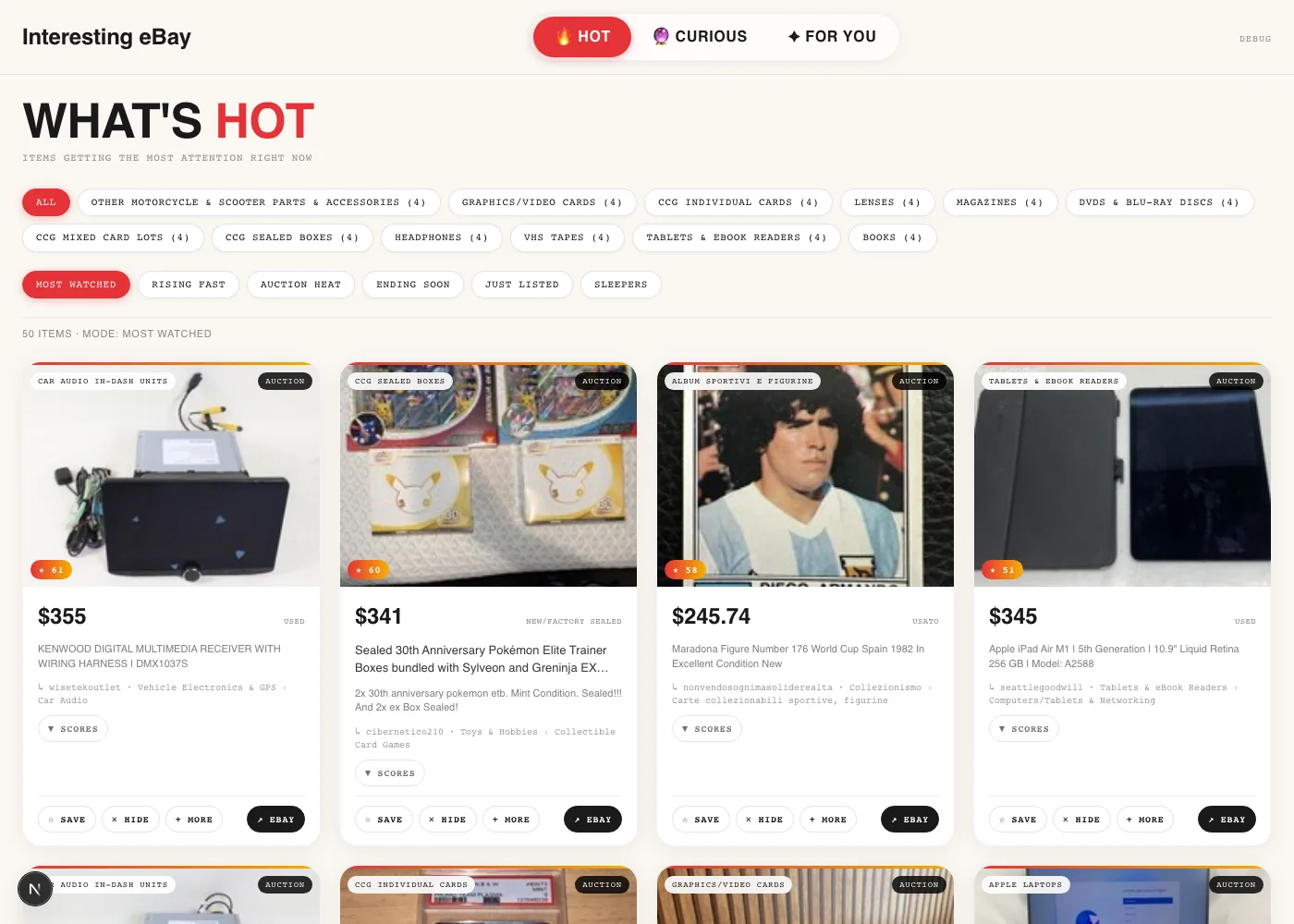
- 1Hot: items gaining bids and watchers fastest right now.
- 2Curious: listings an LLM judges genuinely rare, odd or worth talking about.
- 3For you: shaped by what you save and hide.
How AI makes it work
Keyword matching and popularity can’t tell you that a working 1970s Soviet medical device with documented provenance is more interesting than the hundredth iPhone. An LLM can. It reads each listing’s title, description and photos and returns a structured score on several kinds of curiosity: rarity for its category, visual oddness, a description that reads like a story, unusual provenance or condition. Scoring runs in batches and is cached, and a listing is only re-scored when it changes, which keeps the cost low.
Embeddings do the personalization. Text and image embeddings, generated by models running locally, place listings in one shared space, so someone who saves 1960s Americana might be shown a vintage typewriter filed under office equipment. Listings close to things you’ve hidden drop out.
How it’s built
FastAPI, Next.js, Postgres with pgvector, background workers, local models through Ollama, and an LLM API.
- 1Scheduled sweeps pull 10,000–20,000 live listings a week from eBay’s public APIs.
- 2Hourly snapshots turn bid and watcher counts into velocity for the Hot feed.
- 3Scoring and embeddings run as background jobs; Postgres with pgvector stores and searches them.
- 4The front end sizes each card by its score, so the most interesting finds take the most space.